
Ready for the road: Knorr-Bremse to roll-out redundant braking system for autonomous trucks
Series production of the redundant braking system is planned for 2027
Knorr-Bremse is working with vehicle manufacturers to implement highly automated commercial vehicles
Redundant braking and steering systems form the foundation for safe SAE Level 4 vehicle architectures
Smart driver assistance systems are being consistently further developed: Knorr-Bremse ADAS contributes to greater traffic safety
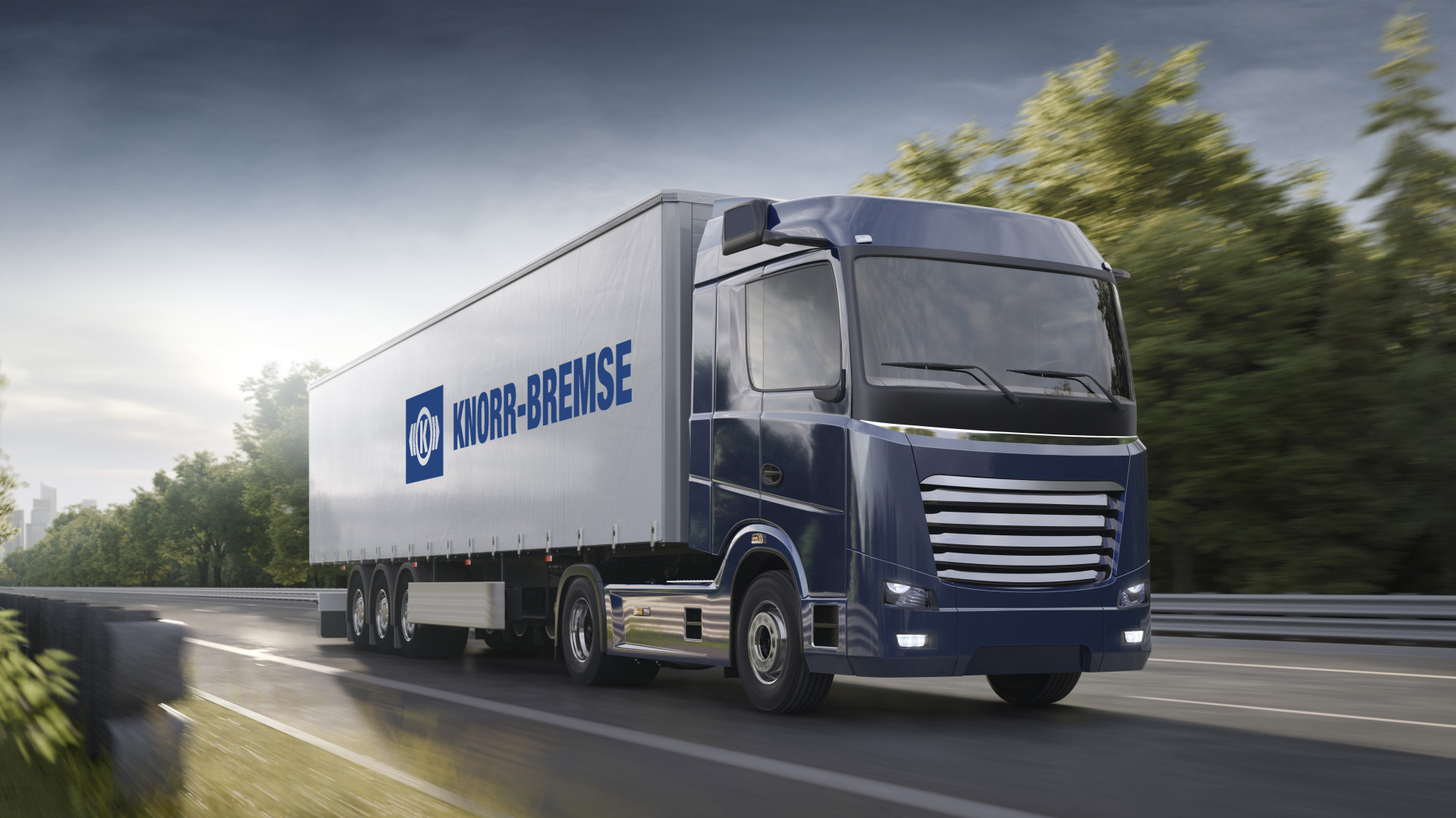
Highly automated driving (HAD) for commercial vehicles is increasingly becoming a reality. Around the world, vehicle manufacturers and technology companies are working to bring such applications to the freight transport sector. Knorr-Bremse will begin series production of its redundant braking system for Level 4 commercial vehicles in 2027, thereby establishing a key technological foundation for safe automated driving functions.
Bernd Spies, Member of the Executive Board of Knorr-Bremse AG and responsible for the Commercial Vehicle Systems Division: “Highly automated driving in the commercial vehicle sector is gaining momentum worldwide—albeit at different paces in different regions. Robust, fail-active vehicle architectures are crucial for the next step. This is precisely where we bring our systems expertise to bear in our partnerships with vehicle manufacturers: We develop redundancy solutions for braking and steering functions and implement them in specific applications together with vehicle manufacturers. The impending series production readiness of our redundant braking system is an important milestone in making Level 4 architectures scalable and economically viable.”
Fleet operators expect more efficient and cost-effective transportation solutions—especially given the driver shortage, increasing safety requirements, and growing cost pressures. Vehicle manufacturers are responding to these demands and actively driving the development of highly automated commercial vehicles. With regard to the first concrete areas of application, North America in particular is emerging as the leading market.
A key prerequisite for the reliable operation of highly automated commercial vehicles is a fail-active system architecture. With automation, responsibility for driving dynamics and safety shifts from the driver to the vehicle—and thus to the technology itself. Redundant actuators thus become the technological foundation for the safe operation of highly automated commercial vehicles. Knorr-Bremse’s fail-active, redundant systems for braking and steering ensure that individual system failures are detected and compensated for, and that vehicle control is maintained at all times. At the same time, redundant braking systems increase vehicle availability by enabling defined operating strategies in the event of a failure—ranging from minimum-risk maneuvers to continued operation with reduced functionality. This can have an immediate positive impact on total cost of ownership (TCO).
Knorr-Bremse’s redundant braking system is based on the Global Scalable Brake Control (GSBC) platform. This platform consolidates the previously diverse range of components into a unified brake control platform. This simplifies system layouts and reduces installation space, weight, and installation costs. Building on this, Knorr-Bremse has developed the rGSBC redundant braking system. The existing architecture is specifically expanded to include a second, independent functional path. In the event of a failure, this path takes over vehicle deceleration with full ABS functionality and ensures driving stability through wheel-by-wheel brake pressure control. Standardized interfaces allow the system to operate both automatically as a “virtual driver” and to be controlled in manual mode at any time. In addition, it supports defined fallback strategies—ranging from minimum-risk maneuvers to “mission-complete” operation.
For steering systems in highly automated commercial vehicles, Knorr-Bremse relies on redundant system solutions. The portfolio includes the fully electric Electric Power Steering (EPS) and its redundant version. The rEPS enables a fail-active steering function in which both the actuators and the control system are designed with redundancy. In combination with the Steer-by-Brake function, this creates an additional independent level of redundancy that enables controlled vehicle guidance in the sense of “Mission Complete” even in the event of critical system failures. The portfolio is complemented by the redundant electrohydraulic superimposed steering (rAHPS), which, as an alternative architecture, supports driver assistance systems and automated driving functions.
Building on this technological foundation, Knorr-Bremse is systematically bringing highly automated driving into practical application: Together with selected customers, the company is implementing specific Level 4 projects and, in the process, gaining valuable system and integration experience. This experience feeds directly into further development—with the goal of scaling the solutions and making them available to a broad customer base.
With the planned series production launch of Knorr-Bremse’s rGSBC starting in 2027, the industrial application of highly automated commercial vehicles is increasingly coming into focus. Initial use cases may emerge particularly in hub-to-hub transport and could be expanded to other application areas in the future. Technologically, the groundwork has been laid: Key elements of redundant vehicle architectures have already been successfully validated—for example, through Knorr-Bremse’s participation in the ATLAS-L4 research project on autonomous driving.
At the same time, the underlying vehicle architectures are continuing to evolve—for instance, toward X-by-wire concepts, in which mechanically implemented functions are replaced by electronic controls. Redundant, fail-active systems ensure that functions remain controllable even in the event of a failure. Regardless of this, software-defined vehicle concepts are becoming increasingly important from Knorr-Bremse’s perspective—featuring centralized control architectures, high availability of sensor data, and continuous software updates.
Advanced Driver Assistance Systems (ADAS) Improve Traffic Safety
Alongside technologies for highly automated commercial vehicles, Knorr-Bremse is consistently driving the further development of modern Advanced Driver Assistance Systems (ADAS). For over a decade, Knorr-Bremse has been improving road safety with its ADAS portfolio—and continues to do so.
With the Knorr-Bremse Fusion Front ADAS, Knorr-Bremse combines radar and camera sensors to reliably detect complex traffic situations. The range of functions includes, among other things, the Advanced Emergency Braking System (AEBS) and its extension with pedestrian detection (Pedestrian Advanced Emergency Braking System, PAEBS), as well as lane-keeping functions (Lane Keeping Assist, LKA, and Lane Departure Warning, LDW). The Advanced Emergency Braking System achieves high detection rates while minimizing false alarms.
AEBS, PAEBS, and LDW all help vehicle manufacturers meet regulatory requirements such as the European GSR II regulation. In the vehicle’s immediate vicinity, the Proximity System is used, which includes, among other features, the Blind Spot Information System (BSIS) and the Moving Off Information System (MOIS).
In addition to regulatory requirements, the commercial vehicle-specific Euro NCAP protocols are becoming increasingly important. These set even higher performance requirements than those stipulated by current legislation. Knorr-Bremse ADAS made a significant contribution to a vehicle manufacturer’s 3-star NCAP rating. Knorr-Bremse is continuously refining its solutions and has advanced ADAS features in its roadmap that, when implemented appropriately, can meet further NCAP requirements.
Meet us at Knorr-Bremse: Hall 12, Booth C21
At IAA Transportation 2026, Knorr-Bremse will showcase technologies and solutions for the future of commercial vehicles—from zero-emission vehicles and highly automated driving to safety and digital services for fleet operations. The experts at Knorr-Bremse look forward to welcoming visitors in person at their booth from September 15–20, 2026, in Hanover, Hall 12, Booth C21.