
Knorr-Bremse wins Europe's first equipment contract over Digital Automatic Couplers
ÖBB Rail Cargo Group and Knorr-Bremse sign Europe’s first commercial equipment contract for Digital Automatic Couplers (DAC)
The key innovation for rail freight transport will be deployed for the first time in commercial fleet operations starting in 2028 as part of the PioDAC project
Contract marks a milestone on DAC’s path to market readiness, industrialization, and rollout across Europe
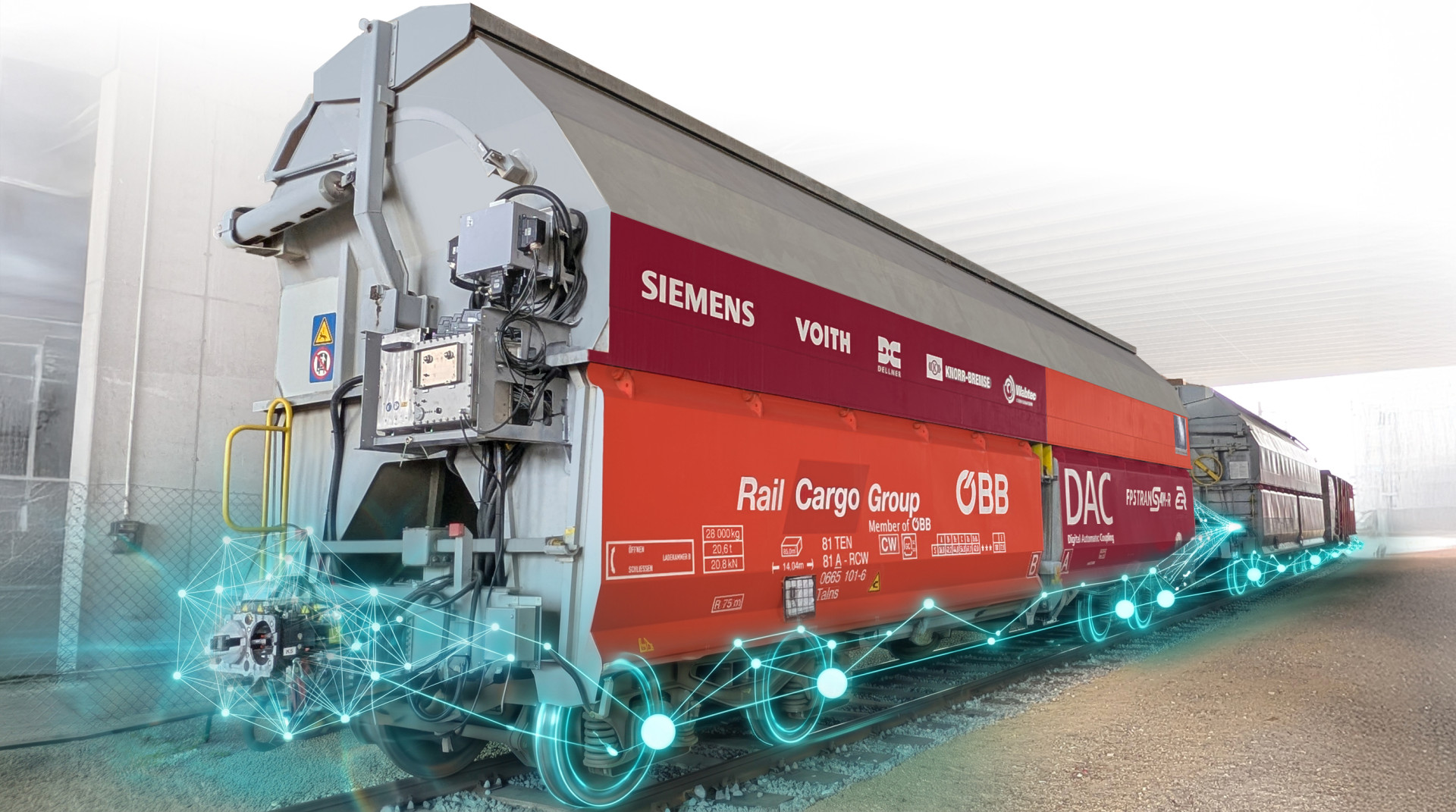
Freight cars that are coupled into trains more quickly, cargo that travels faster – and a contribution to Europe’s climate goals: Through automation and digitalization, Europe can make its rail freight sector stronger and more attractive. Knorr-Bremse has won Europe’s first equipment contract for Digital Automatic Couplers (DAC) from the ÖBB Rail Cargo Group. The breakthrough innovation will be deployed for the first time in the daily fleet operations of a European freight train operator.
“With the first use of the Digital Automatic Coupler in live operation, Knorr-Bremse and ÖBB Rail Cargo Group are taking a major step toward the digital freight train,” says Dr. Nicolas Lange, Executive Board Member responsible for Rail of Knorr-Bremse AG. “The DAC streamlines freight transport processes, increases safety for shunting staff, and makes operations significantly more efficient. ÖBB Rail Cargo Group and Knorr-Bremse are among the pioneers in testing this key innovation. In doing so, we are strengthening the competitiveness of rail freight and laying the groundwork for shifting more traffic to the rails.”
State-of-the-art freight solutions
Starting in 2028, the partners will test the technology’s practical features under real-world conditions as part of the EU-funded PioDAC project (Pioneer Digital Automatic Coupling). The ÖBB Rail Cargo Group’s PioDAC train consists of 23 freight cars and one locomotive. Knorr-Bremse will equip the cars with state-of-the-art DAC systems, including electronic control units, and will integrate sensors for the digital monitoring of vehicle functions and conditions. The project builds on several successful previous projects as part of Europe’s Rail.
The DAC enables faster processes for train formation, preparation for departure, and operations at shunting yards, and contributes significantly to greater safety as well as time and cost savings. The technology replaces manual screw couplings with a modern coupling system that, for the first time, establishes continuous power and data connections throughout the entire train. This allows freight trains to be assembled and separated more quickly. In particular, the time-consuming and labor-intensive coupling and uncoupling of cars will be possible at the push of a button or via a tablet – a major relief for staff and operators.
Digital rail freight: A key growth market
Technologies for the automation and digitalization of trains represent a key growth area for Knorr-Bremse, in which the company targets an annual revenue potential for original equipment in the triple-digit million-euro range for Europe. Knorr-Bremse aims to assume a leading role in Europe, particularly with the DAC, which will be gradually introduced to the market over the next few years. In addition to DAC, Knorr-Bremse is focusing on wireless solutions for fleets, such as FreightControl Sentinel, which already offer clear advantages in terms of efficiency and operational optimization, for example, through digital condition monitoring.