
Investment in India: Knorr-Bremse launches future campus in Chennai and strengthens innovation, growth, and efficiency
Knorr-Bremse invests up to €200 million in modular campus in Chennai over the next five years
Knorr-Bremse deliberately chooses Chennai as technology and AI hub in the growth market of India
New campus will bring together engineering, production, and Artificial Intelligence activities and is designed for up to 3,500 employees in the long term
Major project reflects Knorr-Bremse’s global strategy of consistently combining growth with efficiency and performance
Knorr-Bremse is consistently pursuing its growth path in India. In mid-February, the groundbreaking ceremony took place for the construction of a modular future campus in Chennai, which combines production, engineering, and AI activities in one location. With an investment volume of up to €200 million, the company is further consolidating its presence in one of the most important markets of the future and expanding its local value creation and technology expertise. From the end of 2027, the location will complement Knorr-Bremse's existing development and production sites in Pune and Palwal and host up to 3,500 employees in the long term.
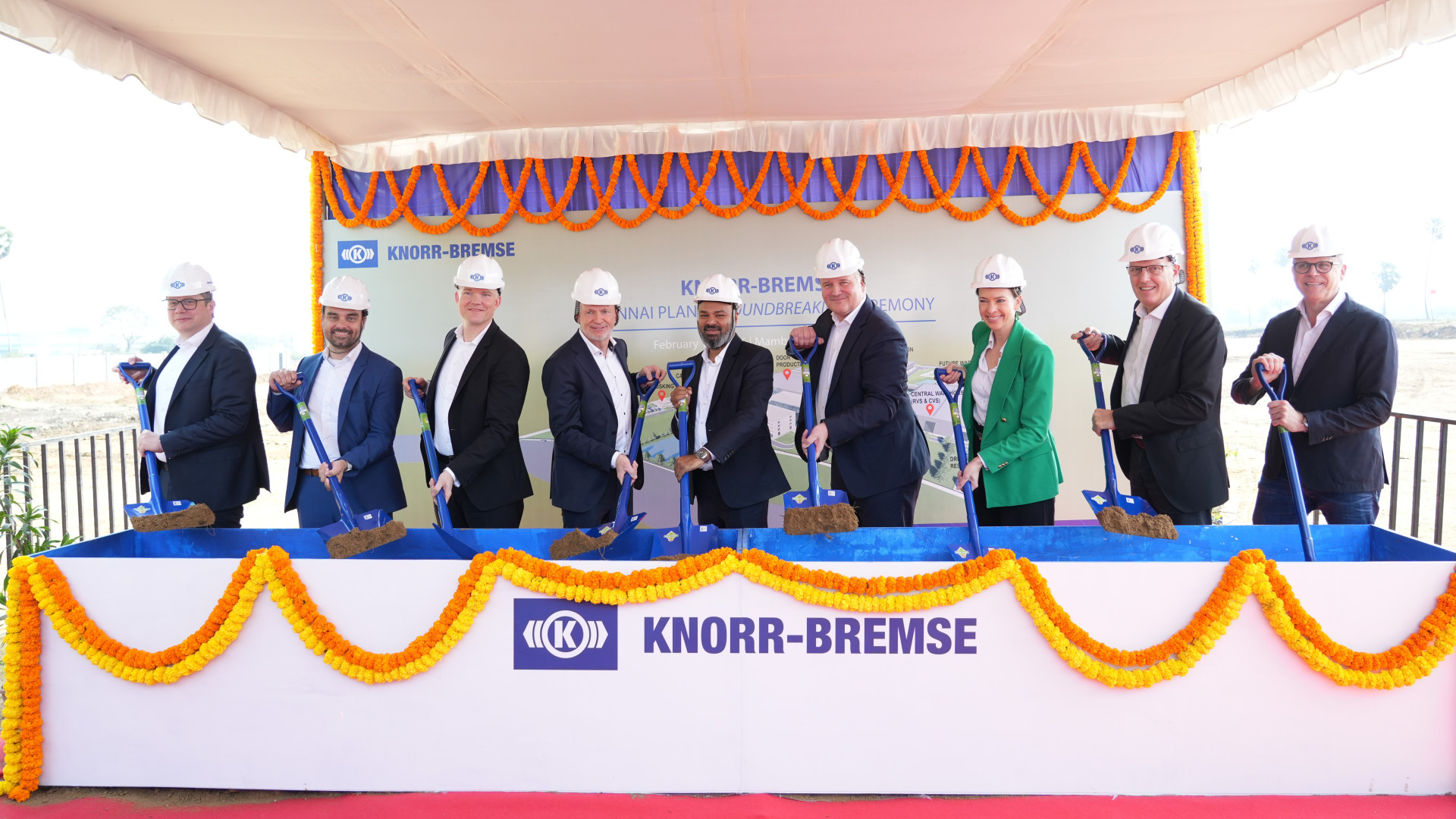
“India is a key region for us with great potential – as a location for innovation, a production hub, and a transport market,” explains Marc Llistosella, CEO of Knorr-Bremse AG. “Our future campus enables us to connect global capabilities even more closely, make processes more efficient, and accelerate projects. This creates a strong foundation for our Rail and Truck divisions to grow profitably – in India as well as in international markets. The campus is an important building block in our global strategy and a clear commitment to Knorr-Bremse’s long-term growth path.”
Investment in the future
Knorr-Bremse will build the cross-divisional industrial facility, which will cover a total area of around 188,000 m2, equivalent to approximately 26 soccer fields, in multiple phases. The first phase will see the construction of production plants for entrance systems for metros, regional and high-speed trains, as well as for braking system components for commercial vehicles, which will commence operations at the end of 2027. Additional office complexes, where employees will drive forward the intelligent bundling of global business and administrative processes, will be completed by 2030 and beyond. Especially with the consolidation of Global Business Services in Chennai, among other areas in HR and Finance, Knorr-Bremse aims to increase its global process efficiency and speed in the long term.
Chennai as a technology hub
In recent years, Chennai, capital of the state of Tamil Nadu, has developed into a leading technology hub with a highly qualified engineering landscape and excellent infrastructure. Knorr-Bremse opened a center for Artificial Intelligence in Chennai in the summer of 2025 as part of its global digital strategy. Being built in the AI center’s immediate vicinity, the new complex can be flexibly expanded thanks to its modular design. In total, the scope of the major project is reflected in Knorr-Bremse’s long-term approach of investing between four and five percent of its annual revenue.
Products for the Indian and world market
The products manufactured in Chennai will be intended for both the Indian market and global export. Knorr-Bremse is thus responding to the expected growth in India in its core segments: freight and passenger rail transport and, increasingly, commercial vehicles such as trucks, delivery vehicles, and buses. Knorr-Bremse is already involved in rail projects in Delhi and Chennai, among others, as a leading supplier of braking and entrance systems for metro trains, and will also equip India’s first high-speed trains with braking, entrance, air conditioning, and sanitation systems. The sales volume of both Knorr-Bremse divisions in India is growing strongly and already amounts to over €300 million per year.
Sustainable certification
Besides, the new campus meets high standards of sustainability and energy efficiency. Among other things, the complexes and their equipment comply with the LEED Platinum standard, which is awarded to particularly energy-efficient and environmentally friendly buildings. The future campus is also aligned with the assessment criteria of the EU taxonomy for environmentally sustainable economic activities. In the first construction phase of the project alone, which will run until the end of 2027, photovoltaic systems with an installed capacity of around 2,500 kWp are planned.